
Post-Traumatic Growth
In 1992, Leonard Cohen released a song called “Anthem” which included these words:
"Ring the bells that still can ring
Forget your perfect offering
There is a crack, a crack in everything
That's how the light gets in."
Trauma can feel like a crack that shifts the ground beneath you, upending everything you thought was solid. It is often perceived through the lens of its damage, but trauma also has the potential to generate growth in unanticipated ways. Psychologists call this phenomenon Posttraumatic Growth (PTG). PTG refers to the strength and understanding that can emerge from traumatic experiences (Tedeschi et al., 2018).
Many people equate strength with resilience, although resilience technically refers to the ability to return to a previous state or level of functioning. PTG goes beyond resilience and extends toward a more empowered way of living after experiencing trauma. Individuals with PTG tend to be stronger and wiser than they were before their traumatic experiences. It is both a process and an outcome; a way to interpret trauma and the changes one experiences from their growth.
What Does Posttraumatic Growth Look Like?
Five measures determine if an individual is experiencing growth:
Increased Appreciation for Life - Noticing and valuing simple, ordinary moments. Seeing life as precious and meaningful.
Relationship with Others - Nurturing healthy relationships and letting go of ones that no longer support your well-being.
New Possibilities - Developing new hobbies, interests, or ways of living. Making changes in your life that reflect your new values and priorities.
Personal Strength - Seeing yourself as stronger than you thought. Feeling capable of handling future challenges.
Spiritual and Existential Change - Rethinking your beliefs and values. Finding new vision in life, a deeper sense of purpose, or a shift in philosophy about yourself and the world.
In working with clients to develop PTG, I have become a steadfast proponent of using Acceptance and Commitment Therapy (ACT). ACT emphasizes that there is not always meaning or redemption in one’s trauma, but that healing can take place through compassion and acceptance. It can be unhelpful to suggest people “find the silver lining” or say “everything happens for a reason.” Trauma leaves a mark, and real healing begins when we allow ourselves to acknowledge and feel that pain.
One of my favorite core concepts in ACT is psychological flexibility. It focuses on approaching life with openness and adaptiveness rather than fear or avoidance (Gur & Reich, 2023). I use it to help clients observe their thoughts without becoming entangled in them and to respond in ways that are intentional and values-guided. If you can learn to resist avoidance and self-judgment, you can open the doors to growth, self-compassion, and a renewed sense of purpose.
How Can You Foster Posttraumatic Growth?
Dr. Richard Tedeschi, a leading researcher on PTG, outlines a few practical steps to foster PTG (Tedeschi, 2020):
Education: Learn how trauma impacts your core beliefs. Understanding it can help you see both the challenges and the growth opportunities.
Emotional Regulation: Practice observing and managing your emotions to implement effective coping skills.
Disclosure: Talk about your experience with a trusted person or professional.
Narrative Development: Write or tell your story to reflect both where you have been and the direction you want your life to go.
Service: Use your experiences to help others. It can bring purpose and meaning to your journey.
Summary
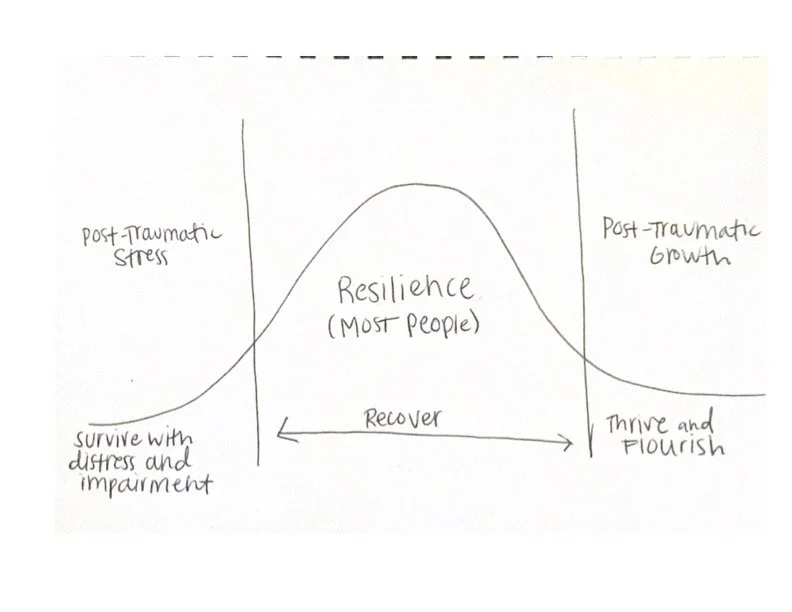
Posttraumatic Growth remains somewhat of a mystery. Research suggests that roughly 50–65% of people who experience trauma also experience Posttraumatic Growth, yet it’s still unclear why it emerges for some and not others (Collier, 2016). I like to hold onto the idea that while trauma can leave cracks in our lives, those cracks, as Leonard Cohen reminds us, are often where the light can shine through. Posttraumatic Growth is about letting that light in and letting it transform the way we live going forward.
Collier, L. (2016, November 1). Growth after trauma. Monitor on Psychology, 47(10). https://www.apa.org/monitor/2016/11/growth-trauma
Gur, A., & Reich, A. (2023). Psychological flexibility of parents of children with disabilities: A systematic literature review. Research in Developmental Disabilities, 136, 104490. https://doi.org/10.1016/j.ridd.2023.104490 PubMed
Tedeschi, R. G. (2020, July–August). Growth after trauma. Harvard Business Review. https://hbr.org/2020/07/growth-after-trauma
